CLARKSTON, Ga. — After fleeing the war-torn Democratic Republic of Congo, Antoinette landed within the Atlanta space final November and commenced to seek out her footing with federal assist.

Separated from her grownup kids and grieving her husband’s loss of life within the conflict, she began a job packing containers in a warehouse, making simply sufficient to cowl lease for her personal residence and payments.
Antoinette has been counting on the Supplemental Diet Help Program, previously often known as meals stamps, for her weekly grocery journeys.
However now, simply as life is beginning to stabilize, she must take care of a brand new setback.
President Donald Trump’s huge funds regulation, which Republicans name the One Large Lovely Invoice Act, slashes $187 billion — or practically 20% — from the federal funds for SNAP via 2034. And separate from any temporary SNAP stoppages due to the federal shutdown, the regulation cuts off entry utterly for refugees and different immigrant teams within the nation lawfully. The change was slated to take impact instantly when the regulation was signed in July, however states are nonetheless awaiting federal steering on when to cease or part it out.
For Antoinette, 51, who didn’t need her final title used for concern of deportation and certain persecution in her native nation, the lack of meals support is dire.
“I’d not have the means to purchase meals,” she mentioned in French via a translator. “How am I going to handle?”
All through its historical past, the U.S. has admitted into the nation refugees like Antoinette, individuals who have been persecuted, or concern persecution, of their homelands as a consequence of race, faith, nationality, political views, or membership in a specific social group. These authorized immigrants usually face an in-depth vetting course of that may begin years earlier than they set foot on U.S. soil.

As soon as they arrive — typically with little or no means — the federal authorities gives sources similar to monetary help, Medicaid, and SNAP, outreach that has usually garnered bipartisan help. Now the Trump administration has pulled again the nation’s decades-long help for refugee communities.
The funds regulation, which funds a number of of the president’s priorities, together with tax cuts to rich Individuals and border safety, revokes refugees’ entry to Medicaid, the state-federal medical insurance program for folks with low incomes or disabilities, beginning in October 2026.
However one of many first provisions to take impact underneath the regulation removes SNAP eligibility for many refugees, asylum seekers, trafficking and home violence victims, and different authorized immigrants. About 90,000 folks will lose SNAP in a mean month because of the brand new restrictions narrowing which noncitizens can entry this system, according to the Congressional Budget Office.
“It doesn’t get far more fundamental than meals,” mentioned Matthew Soerens, vice chairman of advocacy and coverage at World Aid, a Christian humanitarian group that helps U.S. refugees.
“Our authorities invited these folks to rebuild their lives on this nation with minimal help,” Soerens mentioned. “Taking meals away from them is incorrect.”
Not Only a Handout
The White Home and officers at america Division of Agriculture didn’t reply to emails about help for the supply that ends SNAP for refugees within the One Large Lovely Invoice Act.
However Steven Camarota, director of analysis for the Middle for Immigration Research, which advocates for diminished ranges of immigration to the U.S., mentioned cuts to SNAP eligibility are affordable as a result of foreign-born folks and their younger kids disproportionately use public advantages.
Nonetheless, Camarota mentioned, the refugee inhabitants is completely different from different immigrant teams. “I don’t know that this might be the inhabitants I’d begin with,” Camarota mentioned. “It’s a comparatively small inhabitants of those that we usually settle for have a variety of want.”
Federal, state, and native spending on refugees and asylum seekers, together with meals, well being care, schooling, and different bills, totaled $457.2 billion from 2005 to 2019, in line with a February 2024 report from the Division of Well being and Human Companies. Throughout that point, 21% of refugees and asylum seekers acquired SNAP advantages, in contrast with 15% of all U.S. residents.
Along with the funds regulation’s SNAP adjustments, financial assistance given to folks getting into the U.S. by the Workplace of Refugee Resettlement, part of HHS, has been reduce from one yr to 4 months.
The HHS report additionally discovered that regardless of the preliminary prices of caring for refugees and asylees, this group contributed $123.8 billion extra to federal, state, and native governments via taxes than they acquired in public advantages over the 15 years.
It’s within the nation’s finest curiosity to proceed to help them, mentioned Krish O’Mara Vignarajah, president and CEO of World Refuge, a nonprofit refugee resettlement company.
“This isn’t what we should always take into consideration as a handout,” she mentioned. “We all know that once we help them initially, they go on to not simply survive however thrive.”
Meals Is Drugs
Meals insecurity can have lifelong bodily and psychological well being penalties for individuals who have already confronted years of instability earlier than coming to the U.S., mentioned Andrew Kim, co-founder of Ethnē Well being, a group well being clinic in Clarkston, an Atlanta suburb that’s house to 1000’s of refugees.

Noncitizens affected by the brand new regulation would have acquired, on common, $210 a month inside the subsequent decade, in line with the CBO. With out SNAP funds, many refugees and their households may skip meals and change to lower-quality, cheap choices, resulting in continual well being considerations similar to weight problems and insulin resistance, and doubtlessly worsening already critical psychological well being circumstances, he mentioned.
After her husband was killed within the Democratic Republic of Congo, Antoinette mentioned, she grew to become separated from all seven of her kids. The youngest is nineteen. She nonetheless isn’t certain the place they’re. She misses them however is decided to construct a brand new life for herself. For her, sources like SNAP are crucial.
From the convention room of New American Pathways, the nonprofit that helped her enroll in advantages, Antoinette stared straight forward, stone-faced, when requested about how the cuts would have an effect on her.
Will she store much less? Will she eat fewer vegatables and fruits, and fewer meat? Will she skip meals?
“Oui,” she replied to every query, utilizing the French for “sure.”
Since arriving within the U.S. final yr from Ethiopia together with his spouse and two teen daughters, Lukas, 61, has been addressing diabetes-related issues, similar to blurry imaginative and prescient, complications, and hassle sleeping. SNAP advantages permit him and his household to afford contemporary greens like spinach and broccoli, in line with Lilly Tenaw, the nurse practitioner who treats Lukas and helped translate his interview.
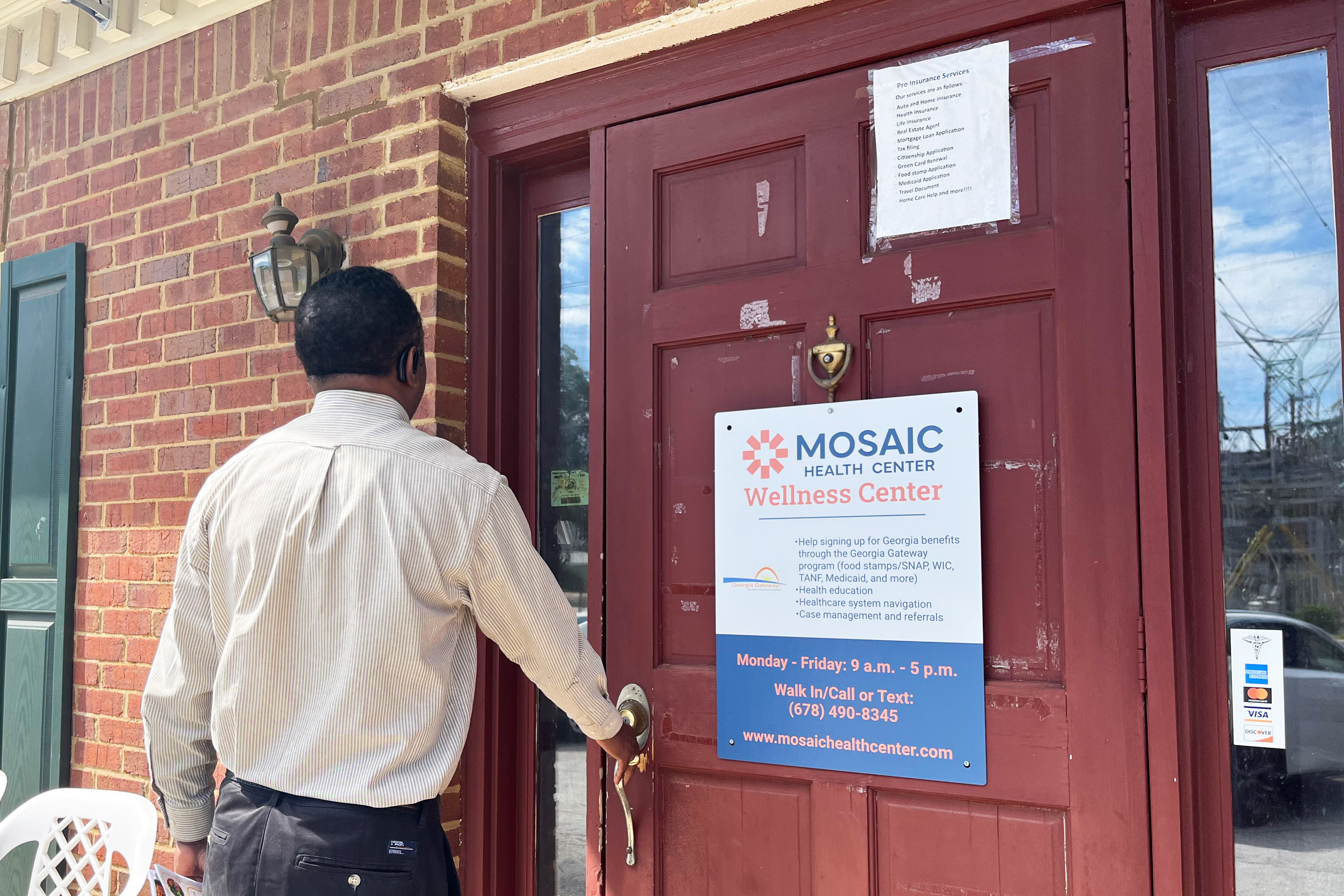
His blood sugar is now at a safer stage, he mentioned proudly after a category at Mosaic Well being Middle, a group clinic in Clarkston, the place he realized to make lentil soup and stability his weight loss plan.
“The help offers us hope and encourages us to see life in a optimistic method,” he mentioned in Amharic via a translator. Lukas wished to make use of solely his household title as a result of he had been jailed and confronted persecution in Ethiopia, and now worries about jeopardizing his potential to get everlasting residency within the U.S.
Starvation and poor diet can decrease productiveness and make it laborious for folks to seek out and maintain jobs, mentioned Valerie Lacarte, a senior coverage analyst on the Migration Coverage Institute.
“It might have an effect on the labor market,” she mentioned. “It’s bleak.”
Extra SNAP Cuts To Come
Whereas the Trump administration ended SNAP for refugees efficient instantly, the change has created uncertainty for many who present help.
State officers in Texas and California, which obtain essentially the most refugees amongst states, and in Georgia instructed KFF Well being Information that the USDA, which runs this system, has but to subject steering on whether or not they need to cease offering SNAP on a particular date or part it out.
And it’s not simply refugees who’re affected.
Practically 42 million folks obtain SNAP advantages, according to the USDA. The nonpartisan Congressional Funds Workplace estimates that, inside the subsequent decade, greater than 3 million folks will lose month-to-month meals {dollars} due to deliberate adjustments — similar to an extension of labor necessities to extra folks and a shift in prices from the federal authorities to the states.
In September, the administration ended a key report that regularly measured food insecurity amongst all U.S. households, making it tougher to evaluate the toll of the SNAP cuts.
The USDA additionally posted on its website that no advantages could be issued for anybody beginning Nov. 1 due to the federal shutdown, blaming Senate Democrats. The Trump administration has refused to launch emergency funding — as previous administrations have executed throughout shutdowns — in order that states can proceed issuing advantages whereas congressional leaders work out a funds deal. A coalition of attorneys basic and governors from 25 states and the District of Columbia filed a lawsuit on Oct. 28 contesting the administration’s determination.
Cuts to SNAP will ripple via native grocery shops and farms, stretching the sources of charity organizations and native governments, mentioned Ted Terry, a DeKalb County commissioner and former mayor of Clarkston.
“It’s simply the entire ecosystem that has been in place for 40 years utterly being disrupted,” he mentioned.
Muzhda Oriakhil, senior group engagement supervisor at Associates of Refugees, an Atlanta-area nonprofit that helps refugees resettle, mentioned her group and others are scrambling to supply momentary meals help for refugee households. However charity organizations, meals banks, and different nonprofit teams can’t make up for the lack of billions of federal {dollars} that assist households pay for meals.
“Plenty of households, they might starve,” she mentioned.