
If you happen to purchase by means of our hyperlinks, we could earn an affiliate fee. This helps our mission to get extra individuals energetic and out of doors.Learn about Outside Online’s affiliate link policy
A brand new research bolsters the declare that collagen dietary supplements may help rework your tendons and muscular tissues
(Photograph: MirageC/Getty)
Revealed August 11, 2025 03:23AM
It’s laborious to say that collagen is a “scorching new complement,” on condition that its well being advantages have been already being promoted by the twelfth-century Benedictine abbess Hildegard von Bingen. In its fashionable type, collagen dietary supplements have been hyped for many years for functions starting from joint ache to hair thickness, regardless of a basic lack of convincing proof that they work. However curiosity has spiked over the previous few years due to a burst of latest analysis, and the newest research on the subject bolsters the declare that collagen may assist construct springier tendons and muscular tissues to reinforce explosive energy.
Why Collagen Would possibly Assist
I first wrote concerning the new wave of collagen analysis back in 2019, and adopted up with extra in 2023. The normal view is that collagen-rich connective tissues corresponding to tendons, ligaments, and cartilage are successfully inert, with very restricted capacity to develop or restore themselves after harm. What collagen proponents argue is that taking collagen dietary supplements provides the important thing constructing blocks—for instance, an amino acid known as proline—that set off the synthesis of latest connective tissue within the physique.
The skeptical view is that collagen dietary supplements are damaged up into their constituent amino acids once you digest them, similar to some other type of protein. In consequence, they’re no simpler for constructing collagen within the physique that, say, consuming a glass of milk (which additionally incorporates proline). There’s, nevertheless, a little bit of proof that some collagen-specific peptides—quick chains of amino acids—make it by means of the digestion course of intact and present up within the bloodstream.
The proof for these claims and counterclaims has been decidedly blended. A part of the issue is that many of the research use some mixture of collagen and particular train protocols in an try to maximise the advantages, in the identical means that protein dietary supplements are handiest for constructing muscle when mixed with energy coaching. It is a good thought, but it surely makes it tough to interpret conflicting outcomes. Did the research fail as a result of collagen doesn’t work, or as a result of the train protocol was too straightforward or too laborious, or too bizarre?
The New Examine
The latest study comes from researchers at Japan’s Juntendo College—working, it needs to be famous, with scientists from Morinaga & Co., which manufactures and sells well being and sports activities “meals merchandise.” Their aim was to simplify the image by learning the results of 16 weeks of every day ten-gram collagen peptide dietary supplements, with no different adjustments in train or weight loss program. They recruited 50 volunteers, half of whom bought the complement whereas the opposite half bought a placebo.
The precise speculation the researchers needed to check was that collagen dietary supplements would make tendons and muscular tissues “stiffer,” within the sense {that a} stiff elastic band takes extra drive to stretch. That is what you’d count on if the collagen dietary supplements set off further collagen formation within the tendons, that are primarily made from collagen fibers, and within the “extracellular matrix” that gives structural help to muscular tissues.
Stiffer muscular tissues and tendons ought to assist you to switch drive extra effectively out of your muscular tissues to your bones, making it potential to ship drive extra quickly. You’re not getting stronger, however you’re getting extra explosive. This type of explosive energy is essential each for athletic efficiency and for actions of every day dwelling like getting out of a chair—and (as I wrote last fall) can also be what we are likely to lose most quickly as we age.
What They Discovered
The outcomes, which have been printed in Drugs & Science in Sports activities & Train, principally help this speculation. They used MRI to measure the scale of the Achilles tendon and a part of the calf muscle; an ultrasound method to measure the stiffness of the tendon and muscle; and a set of energy and energy exams to see the useful results of the supplementation.
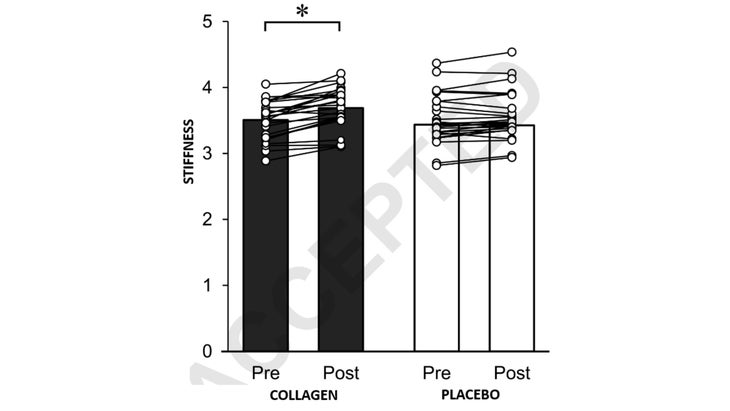
Neither the tendon nor the muscle bought any larger, and the utmost calf energy didn’t change. However the elastic stiffness of each muscle and tendon elevated within the collagen group, whereas staying unchanged within the placebo group. Right here, for instance, is the stiffness (as measured by how briskly an ultrasound wave travels) for the collagen and placebo teams:
Maybe extra importantly, the collagen group additionally noticed a rise in “price of torque improvement,” which is a measure of explosive energy that quantifies how shortly you’ll be able to apply drive:
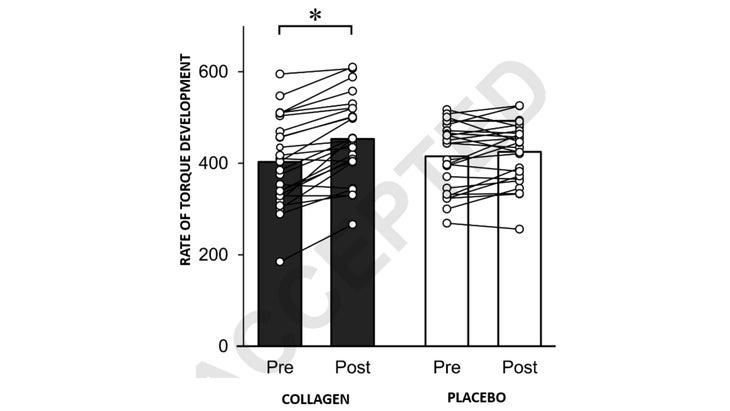
The ultimate piece of the image is that, for particular person topics, those that noticed the most important will increase in muscle stiffness tended to see the most important will increase in explosive drive. There wasn’t a transparent connection between will increase in tendon stiffness and will increase in explosive drive, however general, the outcomes help the chain of logic: extra collagen -> stiffer muscular tissues and tendons -> extra explosive drive.
What the Outcomes Imply
You can also make a a lot larger argument on the idea of those outcomes. Perhaps you don’t care about tendons and explosive energy (although, actually, you should). But when these outcomes are true, then it means that there is one thing particular about consuming collagen—that it’s not simply damaged down right into a potpourri of free amino acids, and that it might set off the remodelling of cartilage-based tissues. Perhaps it actually will thicken your hair; perhaps it’s going to restore your joints; perhaps it’s going to speed up your restoration from ligament accidents.
These are large and as-yet-unproven claims, but when collagen works for tendon stiffness, then the opposite claims develop into a bit extra believable, at the very least in concept. I stay skeptical however intrigued. Given the mess of conflicting outcomes produced by earlier analysis, a single research funded by a complement firm—even with a strong pattern dimension of fifty—doesn’t settle the query both means. However it means that this can be a line of analysis that’s very a lot price pursuing, and that we must always await additional outcomes with curiosity.
For extra Sweat Science, be part of me on Threads and Facebook, join the email newsletter, and take a look at my new guide The Explorer’s Gene: Why We Seek Big Challenges, New Flavors, and the Blank Spots on the Map.

I have been writing Exterior’s Sweat Science column since 2017. I am a lifelong runner, a former physicist, and the writer of the NYT bestseller Endure in addition to a forthcoming (March 2025) guide known as The Explorer’s Gene. I dwell in Toronto.